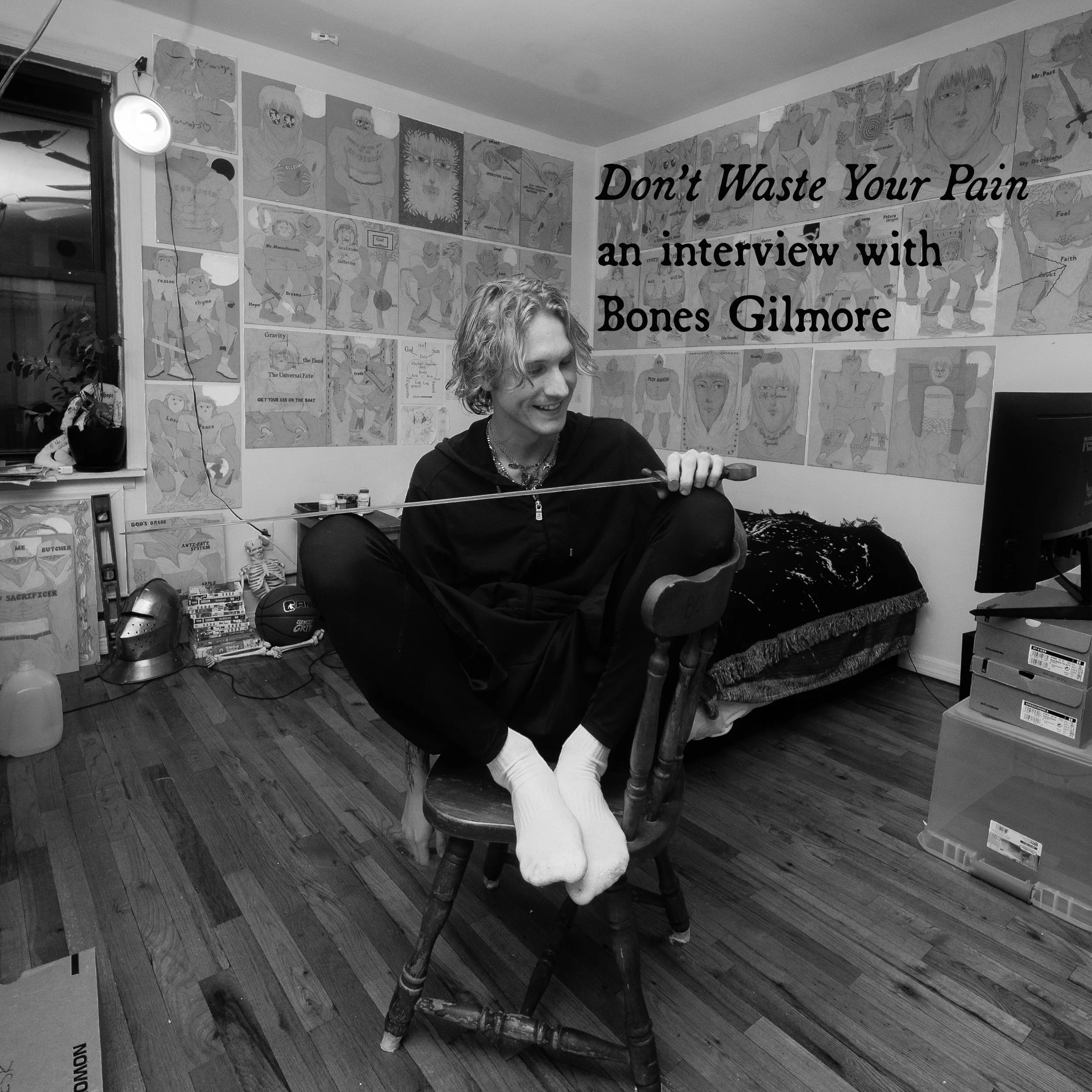
Don’t Waste Your Pain — an interview with Bones Gilmore
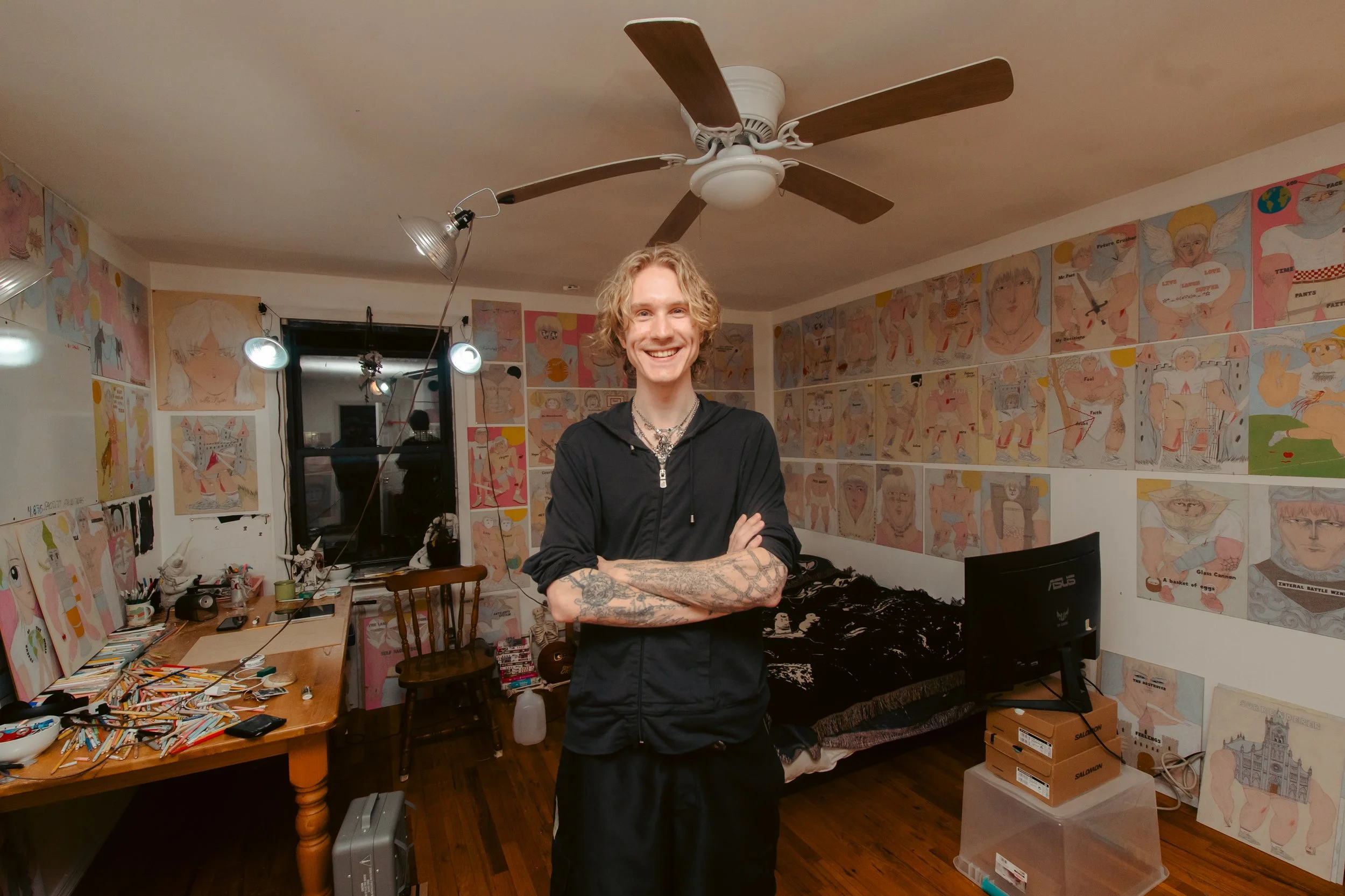
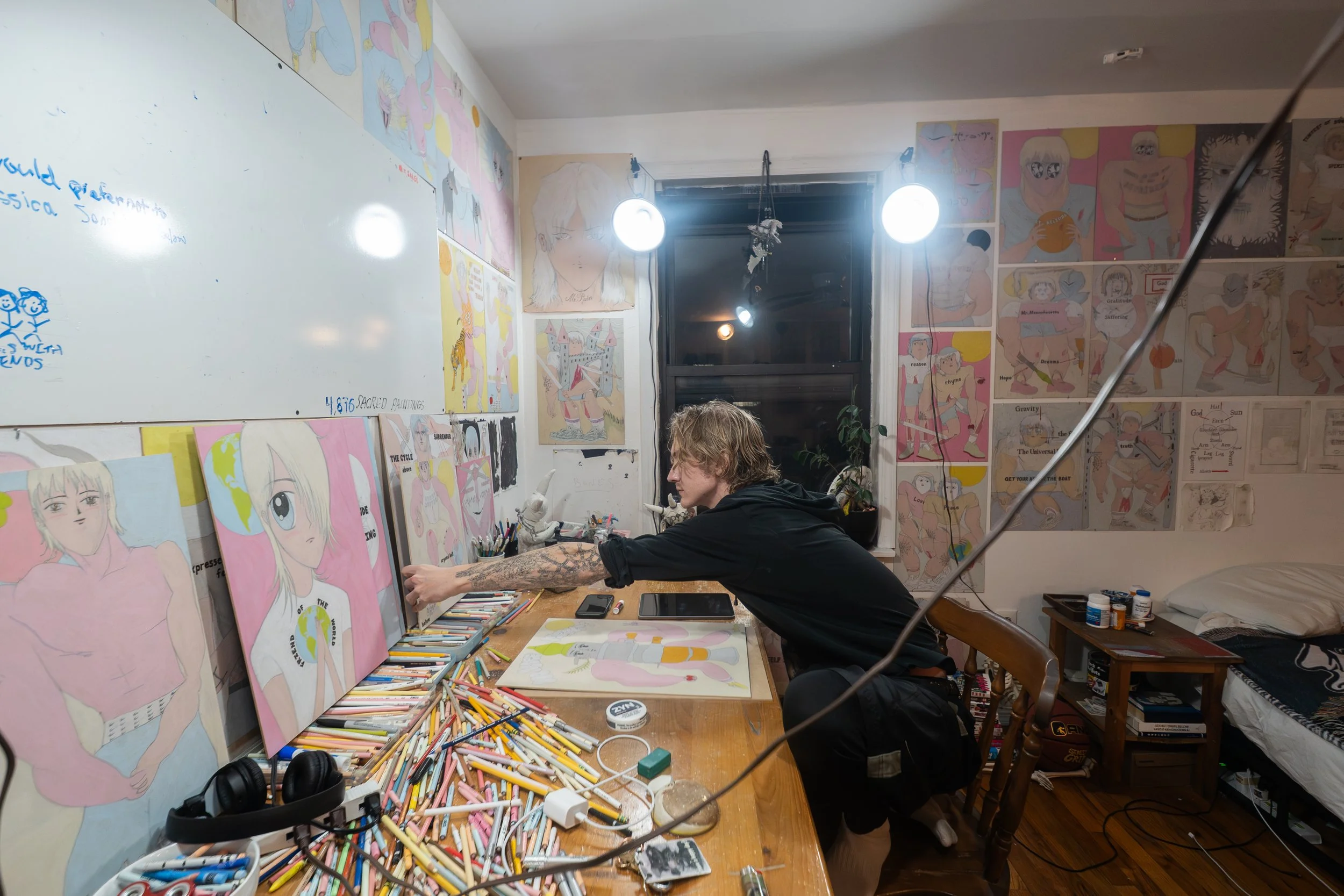
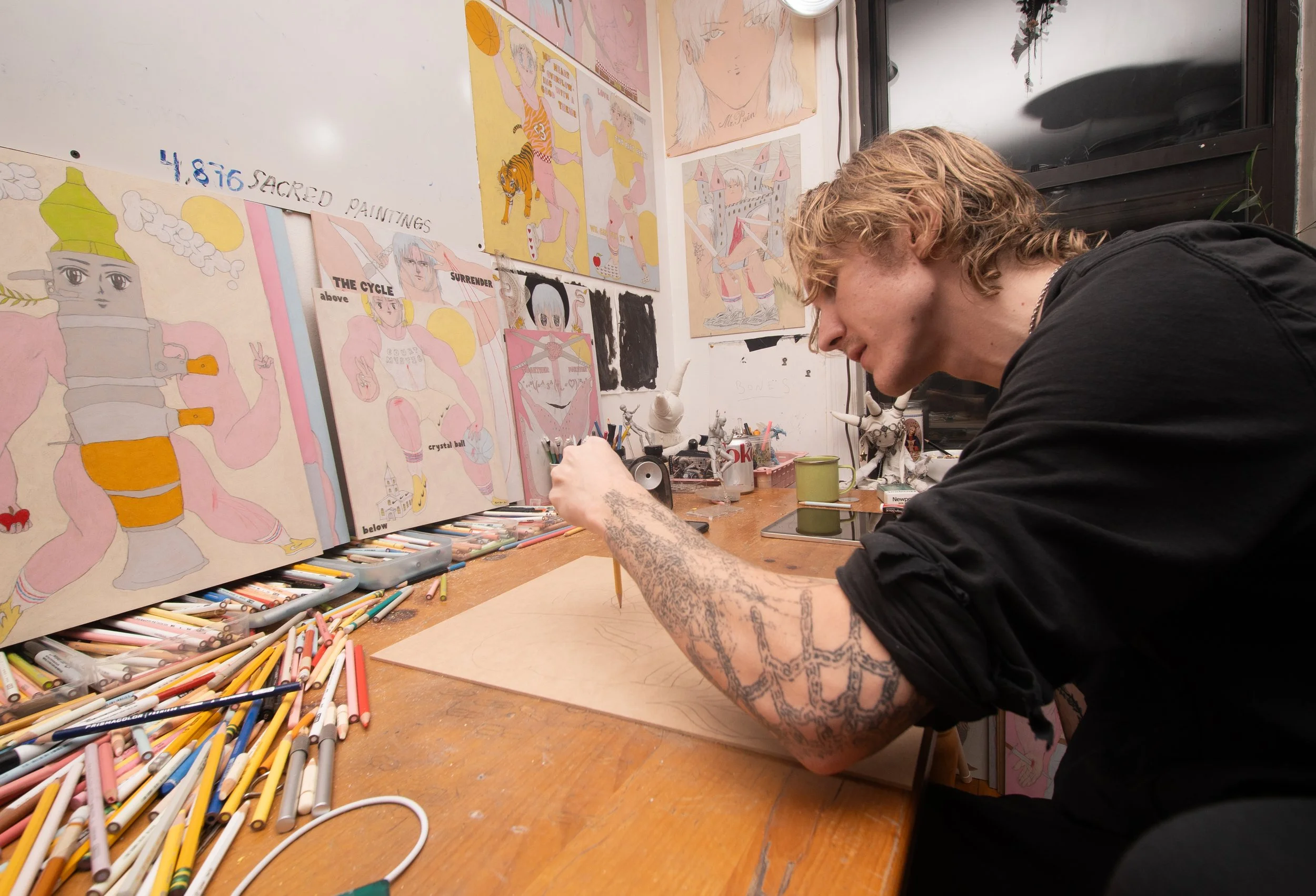
It has been a long time since Bones Gilmore sat down to work and nothing happened. In fact every time he has decided to work for the past year and half – which has been every day – he has produced a new illustration. Every inch of his home studio is covered with his work and if you look around there is even more work stacked and put to the side. For him the drive to make art seems to come from some place different beyond self-actualization, intellectual stimulation, or plain vanity. He views his work, at least in part, as a spiritual practice; as an act of devotion.
Spirituality is a difficult word to throw around in the one-genocide-after-another-and-also-everyone-is-a-pedophile world we currently live in. Most of us have been too fried by the pain that surrounds us at all times to be able to find elation in much beyond black-pilled satirization, our joy increasing in tandem with the absurdity that such a depiction can offer. Expressions of inner pain, struggle, or hope, ring hollow, self-obsessed, and ignorant in this context. Your inner journey? When the world is this fucked up? How can you perceive this depravity and conceive it as grounds for a spiritual experience?
But when I look at an illustration by Bones, my typical defenses and skepticisms are broken down. I’m able to enter into a space in which I can, without shame, think about an inner, spiritual journey. He has mastered the imagery of the contemporary and our current sentiments and instilled them with a timelessness typically reserved for things we might refer to as “fine art”. But the institution and all of its misdeeds doesn’t loom over his art in image or influence. His visual language emerges equally from classical sources as it does from the niche crevices of his instagram feed. Additionally, Bones has amassed a following primarily through his own independent marketing and media, not through the compromises of art world elbow-rubbing. And so the phrases that pervade his idiosyncratic, post-internet-folk art like, “Spiritual Giant, Tempest of Hope”, or “There is no such thing as a thief in God’s orchid,” feel less tainted and much realer than they would if encountered elsewhere. Bones’s work nullifies the streams of irony and doubt that our media has injected into our brains and presents us an alternative. His art encourages us to speak to each other, genuinely. Not in denial of the burning, stupid world around us. But in truthful, genuine, spiritual embrace of it.
I spoke with Bones about some of these things recently as well as about sobriety, what it has been like to run an art career by himself primarily through social media, and some of his influences.
I wanted to start talking about this cycle of work compared to where you were prior. 2025 seems to be the beginning of this particular style and pace of work and I wanted to know the process of how we got here.
There was stuff I was making in school that was a lot of painting but I also always had a separate, removed sketchbook practice. And when I worked small I noticed I would do cartoonish stuff which was completely different from how I would approach painting. I was trying to paint in a very specific way that was more fine art I guess. I was kind of all over the place in school. I was also brutally addicted to drugs and I was drunk all the time, which was definitely a factor. I had a style but I also wasn’t totally sure what was going on in general.
It feels necessary to talk about sobriety in relation to this process because I went into detox right after I graduated. My senior thesis was all 8’ x 4’ paintings that were abstract and landscape and about alcoholism, then I went and cleaned up at detox, and I’ve been sober since. And through sobriety I found spirituality which is a big factor in my current work. And through that I got tapped into all this other stuff that sort of directed me toward what I’m making now.
Living in New York has been a big factor as well. The first year I lived here was the first year I was sober and I didn’t make any art that entire year. Because my artistic identity was so tied up in being drunk. That was my art practice – getting fucked up. So I’m living in New York for a year and I have no space to make art the way I’m used to. I have no room to make a big painting because I’m crammed in a little apartment. So I started doing small characters on paper here and there. Then I was working in this woodshop that had MDF (medium density fiberboard) everywhere. We would build everything out of it. So I started working on that.
And things lined up a little timing and pace wise after that. I sort of half quit half got laid off from the woodshop at the end of 2024 which brought me up to 2025 where this style and this pace and themes all started.
I’m not totally sure how to describe that year because it was sort of all over the place but I knew I wanted to make characters and I knew I wanted to work on a particular size of board – 14 x 20 mdf – and I knew I wanted to make a piece of art every day. And that’s what happened.
I’m curious about influences. There are some things that seem clear like anime but I was wondering if there were other periods and styles that might not be so apparent on first look.
Yeah, medieval art is huge to me and this style. It’s all symbols and flat perspectives and blocks of color. Like illuminated manuscripts. Anime is an obvious one as well. But I’m also just incredibly influenced by my phone. I’m on it all the time and it deeply influences my work.
I wanted to talk about the phone, yeah. There’s an interesting confrontation with the modern world and the internet going on in your work. The use of branding or meme structure and language. I saw one that even alluded to a viral challenge: Mr. Serious No laughing challenge: difficulty impossible. I sometimes avoid incorporating the ultra-modern into my own work because I’m scared it will get in the way of some bigger truth or aesthetic. But your work seems to do the opposite. You seem to be approaching these big ideas through the artifacts of the ultra-modern.
I feel like there’s internet art and post-internet art. Ever since the internet arrived everything is filtered through it and I just don’t see a way around that. This was all made after the internet had been existing for however long and so even something like spirituality, which is ancient, is filtered through the internet. There is no God in the phone of course, and you need to be careful what you pick from the phone visually, but there are powerful and spiritual images on the phone.
I’ve been careful about what symbols I include. The characters look like they come directly out of a cartoon or an anime and there are brands but I don’t think I could ever do something like draw a cellphone.
Someone called my work post-internet folk art which I think is pretty cool. Because I want to make something that is aware of the internet but not consumed by it. My reach as an artist is completely dependent on instagram. There is no denying that. My art exists primarily there for most people. But I still want to make an image that I consider timeless and not exclusively a product of the 21st century.
Could you talk a little bit more about your concept of spirituality?
I say that I have a robust relationship with God. And the footnote on God is it’s not a specific god but more just a placeholder name. Higher power is also a good word for it. I would say my spirituality is very DIY. I didn’t grow up with any religion and I don’t belong to one now. But I have some strong beliefs. I sort of can’t believe that I believe the things that I do. But I believe that God is everything. That it is the totality. And I believe that everything happens for a reason.
Some of this is difficult to verbalize. Someone said to me that if you knew how to say it you wouldn’t need to make a picture, which I think is true. I’m not very eloquent about this or good at explaining it.
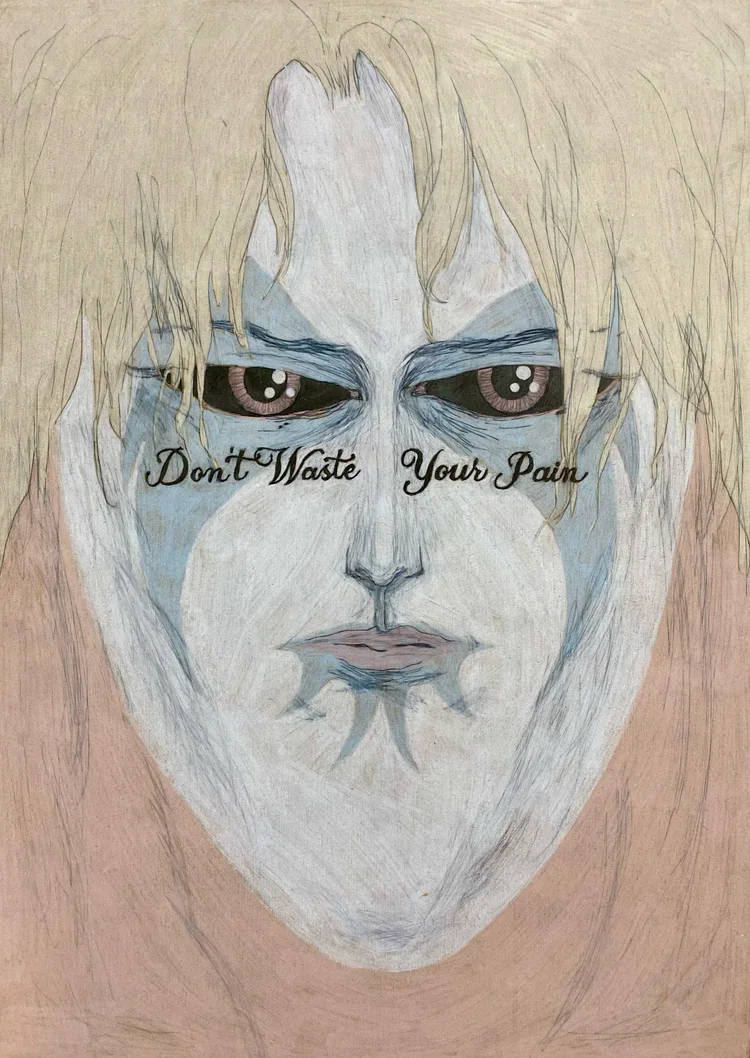
What does the phrase Don’t waste your pain mean?
I heard it in this movie Saint Maud and it stuck out to me. I’ve suffered a lot and made myself suffer a lot through my old lifestyle and for a long time I didn’t see any reason behind it. But through making art and sharing art I’ve seen that those experiences all have value and a purpose. I don’t have to suffer. I’m going to be in pain sometimes but I don’t have to suffer. And pain is okay. It’s the origin of growth. That’s how you become stronger. The phrase is a reminder that everything is meaningful. It’s also so confrontational which I like. Like telling someone who hurts that they shouldn’t waste it. It’s a little funny.
There’s also this quote from Simone Weil that informs a lot of this work as well. It’s “Love of God is pure when joy and suffering inspire an equal degree of gratitude.” And I think that connects directly to the idea of not wasting your pain. Believing in God as only the good stuff and not the bad stuff is where faith can really break down I think. Like if someone you love dies it’s easy to go, Well I guess God doesn’t exist. But maybe all these things that cause pain happen so we can share the strength of going through that experience with someone else. Everything is meaningful. Even the stuff that hurts.
I wanted to talk about the rate at which you’re making stuff. You said earlier that you’re making one illustration a day and always finishing in one sitting.
I got into a serious groove last year which was really weird and unlike how I’d worked in the past. But it was a combination of so many different things that led to working like this.
For one it became my sole source of income. Which was incredibly motivating. I’m now living my childhood dream of being a full time artist and getting paid for my work. And I would be crazy to waste that. I take it very seriously and try to practice a lot of discipline around it. So there is a simple “This is how I pay rent” component to the pace.
It’s also part of how I’m designed as a person. I really just want to draw so bad. When I’m drawing I’m so happy. It’s my favorite thing to do. So the rate of work seems like a lot but I can draw all day if you let me.
The work itself is also pretty self indulgent and emotional and directly about how I’m feeling. Which is helpful because it’s kind of therapeutic and it feels like a process that I’m going to go through either way. But in terms of material the work is simply tied to my day to day emotions in a way that I’m never really stuck on what I should make next.
In the middle of 2025 I reached this point where I felt a lot of the technical barriers to my work had been removed as well. I wasn’t making drawings that I didn’t like anymore. Having a negative outcome for a piece used to really set me back. If I ended up with something I wasn’t excited about I wouldn’t want to draw for a while and that sort of slowed me down. I would be like, Damn, I just don’t got it, and stop drawing. But I think in the middle of 2025 I honed in on what I liked and it just kept coming.
There are also a couple formulas I use in the work that make it easier to produce at a high rate because I’m not forced to generate ideas from the ground up every day. I do characters in similar poses and put something in their hands. That’s the core of it. And on days when I don’t really have much coming to me I can do the character and once I’ve drawn him out I can usually put something together with labels and symbols that will make the image feel distinct.
Last year I made 225 drawings all of this same size. Which is like .6 drawings a day. Which is pretty good. There was still a lot of downtime to the point that I felt like I was living a normal life. And I’m not obsessed with making more drawings than that this year. I’ve checked in with myself about that and I don’t feel in competition with myself.
On top of this you’ve been doing digital art as well, right?
Yeah, another development that has happened quite recently is that I got an iPad which I can make like ten to twelve images a day on. And when I started posting those I got like another twenty-thousand people following my page. It’s a very different vibe from my other artwork, but it’s given me a space to create all the ideas that aren’t important enough to go on the panels.
It’s been a lot of fun. There are simply physical limitations to drawing the characters on the panels. My hands just start to straight up hurt and sitting at the desk is hard. So I’ll move to my bed and draw on my iPad. And the approach is refreshing. Drawing on the panels isn’t necessarily high stakes but I approach it with a lot more seriousness. Those are the things I want to put in shows and be known for. And so I put a lot more emotionally and technically into them.
It’s good to have an additional practice aside from the main thing. I think it provides some relief from the pressure we put on ourselves and lets you return with fresher eyes.
I totally agree. When I started drawing digitally I wasn’t really sure how it was going to interact with my artwork. But it’s been great. I think I’ve learned to draw better honestly. There are really no limitations to working on an iPad so I think I’ve just been able to get some more practice I otherwise wouldn’t have.
Posting them has been interesting too. People sort of go crazy for the digital stuff. And it allows me to test out some ideas that I probably wouldn’t approach with the normal drawing and see how people respond to it. Like I’ve been drawing Spongebob a lot. Which is stupid and I would never do it on the panels but doing it has let me see something about releasing a little more humor into my work. Like I just got done with a kind of ridiculous drawing on the MDF of a guy whose body is a rocket launcher and I probably wouldn’t have done that a month ago. But the digital work has really let me loosen up.
I wanted to talk about sobriety a little bit as it relates to making art and the holistic enthrallment that a creative experience can offer. Do you think your drive to be as prolific as you are comes from a similar space as addiction?
I think that I definitely operate in extremes. It’s like excess or deprivation. Always. Moderation is an alien concept to me. But I try to be pretty conscious about when it’s unhealthy or when I’m thinking about making art, sharing art, or my art career in fucked up ways.
If I make something that is popular my phone will be blowing up all day. And that’s not the only motivation for making art but if I continue to make work every day I know I’ll get a lot of attention. Which is crazy and kind of embarrassing but it’s also true. I have a large audience now and the notifications are awesome. It feels good to see a large number on my phone. And it motivates me to keep going.
And I probably am addicted to drawing. It makes me feel good and when I’m doing it my head is in a different zone and time passes differently. It’s really rewarding to start with nothing and then bring something into the world in a few hours.
I wonder how this lines up with your spirituality or simply your concept of human nature. I feel like humans are sort of not meant to be in a resting state. And we’re constantly torn by this need to be occupied by something other than ourselves. And living in the modern world we’re offered an abundance of things that can fill this void that can ultimately lead to our demise if we aren’t picky about what we choose. In your eyes can you see this practice as a sort of positive addiction?
I’m not a chill person. I’m always moving. I’ve been diagnosed with ADHD but I think it’s way bigger than that. Compulsively I need to be doing something. The idea of positive addiction is really interesting. It reminds me of another word I really like which is devotion.
There’s an artist I’m really inspired by named Howard Finster. He has this crazy story. He was painting a bike one day and he got paint on his thumb and he hallucinated a face in his thumb that delivered a message from God that instructed him to make 5000 sacred paintings to spread the gospel. And depending on how you look at it, that’s obsessive and delusional and neurotic, which are all things that can show up in my own work, but it’s also devotional. It’s a devotional way to practice. He wasn’t a formally trained artist. He was just cranking these things out and when you look at them you can tell he felt he really needed to make these things. I want some of that to be alive in my work as well.
On top of that I do have some evidence that the work I make is helpful to people. Which helps justify the practice a little in my head. Having your job be art making can feel crazy and a little listless. Like how am I helping or contributing to the world? People will try to say making art is labor but to me it just isn’t. I’m having way too much fun when I’m working for this to be considered labor. But learning that people are helped by my work makes it feel worth it. As long as my life is balanced and I’m taking care of myself, this is my job and I’ll keep doing it and having a blast.
Could you speak a little bit about some of the recurring images? I’m interested to hear about the swords and armor.
For swords I’ve always just thought swords are tough and cool. Growing up whenever I was feeling really frustrated or depressed or stupid I would always draw someone with a gun to their head. And that became a symbol I would use over and over. It is the same impulse as drawing the guys impaling themselves or being injured. The sword can be defensive or offensive. The same with armor. It can block and protect but it can also insulate.
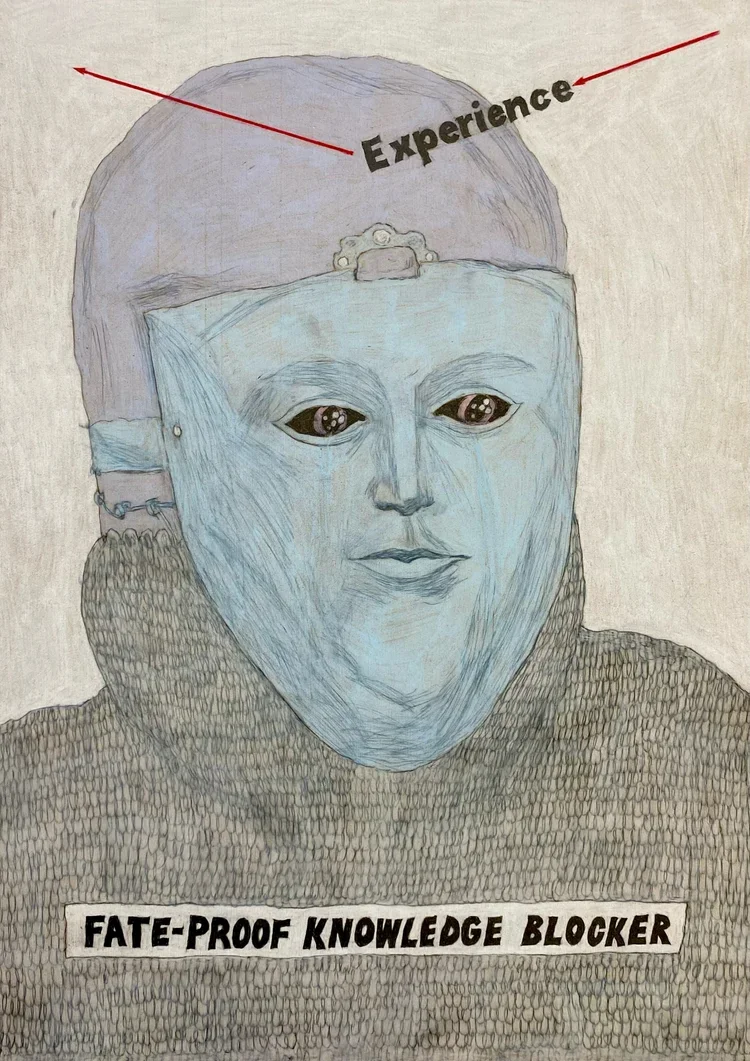
I did one that was Siberian bear armor and I wrote “Love repellant needs haver” on it which is pretty corny in hindsight. This guy needs love but is wearing the suit that blocks him from it. There’s another one where experience is pinging off the armor and is labeled “Faith proof knowledge blocker”. So again this thing that’s supposed to be protective ceases to be when taken out of the correct context. You’re supposed to take armor into battle but in some cases it’s just blocking you from learning.
A lot of them have symbolic wounds as well. The knees are always bleeding because they’re praying so much.
Your apartment is covered in your work. You mentioned to me before we started that you visited Howard Finster’s house and it was sort of like that too. Have you noticed anything happening in your work now that you’re kind of living inside of it?
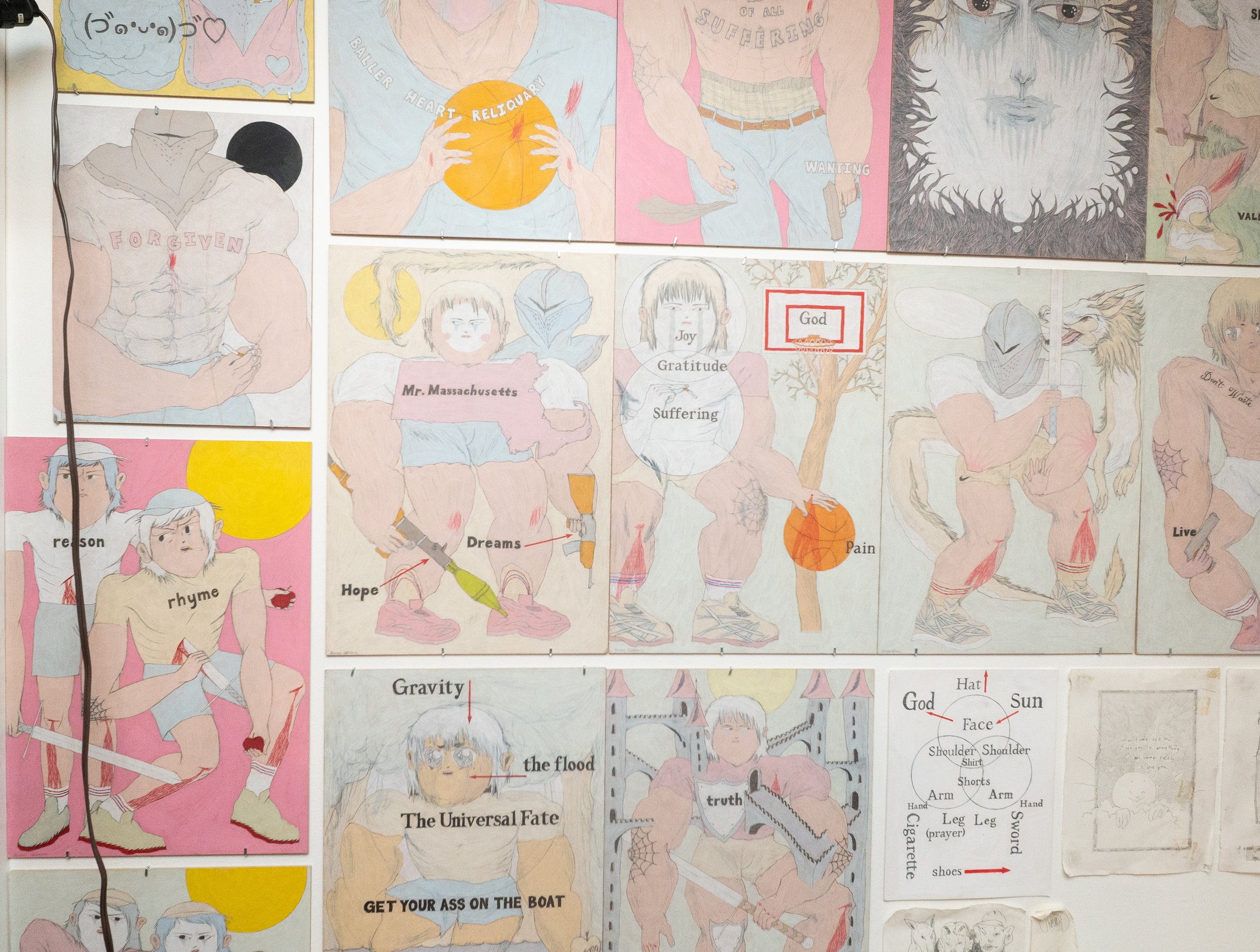
Yeah I went to Howard Finster’s home and it was also covered in his art. You can see everywhere he was working on something — that really inspired me. My apartment here is covered in my work. There was a time where I would just stack everything in one big pile but after seeing that I started covering the walls with it.
It’s a lot of fun. I like my work a lot and I like being able to curate it a little. I’ve made enough now that if I sell something it’s not a huge blow to my inventory, so if I’m really into something I’ll just keep it. It’s cool too because I can use them directly as a reference. It allows me to see what certain combinations of colors look like next to each other or find an expression I want to match. If I’m trying to make something new and distinct I can figure out what I’m making a lot of and what I need to break away from. Living like this sort of invites departures to avoid everything looking the same. I feel like I don’t really have any limitations. Sure I have a visual language I’ve developed but I can also depart in big and small ways, and I think I’m always trying to. I recently got these posable figures and I instantly started doing more dynamic images.
I was in a smaller room before I lived here and I worked in a really crazy fashion where I would use my bed as a desk. But I had limitations on how I could present my work in the room. Everything would just go on the wall in front of me. Now with this space I can rotate the work so that the newest work, or whatever work I’m trying to have my head in and think about, can be in front of my work space. So now the developments are being made through looking at something like the most recent three, instead of twenty different pieces.
I’ve been a lot happier lately as well, which I won’t get into detail about why, but seeing the shift in my work take place on my walls has been really interesting to watch. Like just to the left of us I can see how dark and miserable those all are and then there’s this little shift occurring right over the desk.
Is there a difference in your mind between stabbing yourself in the leg and stabbing yourself in the stomach?
Yeah totally. The sword in the leg is like doubt. You can’t really get on your knees to pray if there is a sword in your leg. And then stabbing yourself in the stomach is much more vital. Your spirit is there. You probably wouldn’t stab yourself in the leg to kill yourself.
I wanted to talk to you about Massachusetts because I feel like it’s relevant to the spirit of your work. I feel like a place like Boston and where you’re from on the Cape can be incredibly harsh and repressive. The weather is tough and the people can be very hardened and clearly burdened by these negotiations in their heads of how much of themselves they need to put out into the world in order to survive. But it’s also an artistic hot bed and known as a place where many people go to express themselves. I was wondering how influenced you felt by all this?
So much and in really weird ways. I think growing up on Cape Cod I was always aware of it as an artistic landmark. Provincetown is known as an artist community and there are just a lot of artists on Cape Cod. But I remember super early having a very visceral reaction to the type of art that is made on Cape Cod. It’s a lot of beach art. People being on the beach and painting the beach. I thought that was so stupid.
Cape Cod is a beautiful place and it’s so much better than so many other places that I could have grown up at, but I felt very isolated there. And in the winter the population drops to a fifth of the size it is in the summer. So it just feels a little dead for half the year. The Cape is also very isolated from the rest of the culture in Massachusetts. You don’t really hear about what’s going on in somewhere like Western Mass or Boston if you’re living there. So I felt very not in the right place, but I also didn’t really know where else the right place could be. I’ve come to love it now but at the time that’s not how I felt.
I made a drawing labeled Mr. Massachusetts and it was mainly a joke. Because I just don’t really identify with the state at all. I don’t really feel any connection to it. And I’ve been away from it for nearly ten years now. But it is a place that has a vibe that I think about. It feels like there’s some darkness around it. I think the whole northeast has a sort of ancient darkness around it that I’m interested in, but you can really feel it there. The entire northeast is a bleak and depressing place in the winter but the beach in the winter is even worse. It’s similar to hell in my opinion. Like if it’s been snowing for a bit, and then one day it’s raining, and you’re on the beach, and it’s completely gray, that’s what hell looks like.
I visited New Haven and felt it there too. You feel the divide between the academic powerhouse and the economic depression that surrounds it. The Cape can be like that. There are five million dollar beach houses and then a quarter mile down the road people will be seriously struggling. And that’s always shaped my thoughts on the Cape. If you say you’re from the Cape people will have this image in their head of what that means and it’s rarely how it is.
A lot of your popularity has come through Instagram. Could you tell me a little about creating and running an art career primarily through the internet?
I don’t really interact with people that are fans of my art in the normal world very often. It’s almost all through instagram. That’s where all my sales come from and every show I’ve been in has come through there. People will say I’m their favorite instagram artist and now that I’m doing digital art people will straight up just call me an account. Which is crazy to me because there are so many ancient, timeless, and spiritual elements in the drawings but to so many people now I’m just an account. Most of my stuff has not been seen by my audience in person. It all occurs online for them.
I’m attempting to create a fine art career. That’s what I’m after. And so much of my day is spent just thinking about marketing. Or responding to DMs, which are just basically fake emails. But it’s all so much more casual because it’s coming through Instagram. I’m super thankful for Instagram because it’s made all of this possible but it also makes me fucking crazy. My screen time is like seven hours a day. If I’m drawing I can’t even get myself to put my phone away for more than ten minutes. It’s almost always open next to me because I’m either waiting for a message or about to send a message.
Analytics are also a crazy element to all of this. I have access to all the numbers associated with all the drawings that I make and then there’s this invisible force, the algorithm, that plays a huge role in how things get seen and become popular. So I can see and be influenced by something like, oh, a drawing that includes a basketball will do better than one without one. And I just shouldn’t have that information.
I feel like everything is about instant gratification right now and my art practice feeds into that pretty easily. I can’t really handle working on something for more than a day. That’s why I crank them out in one sitting. I still don’t really know what I have to say about it because all of this has been such a blessing but there is certainly a very crazy element to it.
The last thing I’ll say about all this is that there is also an element of censorship I feel starting to pressure me. I made a drawing recently that was of a guy with a gun to his head and the gun was labeled “Hope”. And it got reported and my profile got flagged. Then there was another drawing of a guy impaling himself and pointing a gun toward the viewer and it said “PLEASE FORGIVE ME” and that one was reported and flagged for promoting suicide. And if you get enough strikes on your profile it basically just gets nuked. So I feel this pressure of censorship. That was the first time I’d been really confronted with the value of the instagram profile. I just wouldn’t have any of this without that profile. And it really freaked me out how easily it can go away.
Where is your work heading next?
My work changes pretty significantly month to month. I’m sort of just figuring out how I feel about digital art too because it reaches a lot of people. So I’ve been thinking a lot about how I can take the things I’m doing there into a more fine art zone. I just got a toner printer that’s just black and white and so I’ve been covering my bathroom with those digital drawings and thinking about what I can do with them. I feel like the last interview I did they asked me this and I said how badly I wanted to get back to painting, but I just had a pretty big break through that I don’t want to go back to painting. That I actually just don’t like painting. I’ll probably keep making small drawings and watch how they change. With the volume of art I make in conjunction with whatever else is going on with my life it’s going to change and be different whether I want it to or not. I’m just going to see what happens.